 Ice Breaker Games
 Question Swap
Everyone gets a question card, pairs up to ask and answer, then swaps cards and finds someone new. Keeps people moving and meeting without awkward small talk.
Group Size:
10-200 people
Duration:
5-20 minutes
Difficulty:
Medium
How to Play:
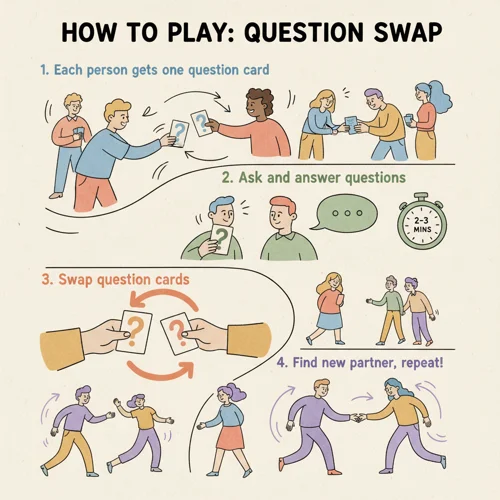
- 1
Hand out one question card to each person
- 2
They pair up: Person A asks their question, Person B answers (2-3 minutes)
- 3
Then flip: Person B asks theirs, Person A answers (2-3 minutes)
- 4
When done, swap cards with each other
- 5
Find a new partner and repeat with the new question
- 6
Continue for 5-20 minutes based on group energy
Question Swap builds movement and conversation into the same mechanic. Everyone gets a question card, finds a partner, asks and answers, then swaps cards and moves on. The swap is what makes it work—people control their conversations but the structure keeps them circulating.
In ten minutes, someone might talk to five different people without a single awkward “so what do you do? ” moment. The introverted designer asks about favorite books and discovers a shared love of science fiction with someone from marketing.
The new hire learns what project the CFO is most excited about. These aren’t forced networking connections—they’re real conversations that happen to occur with strangers.
Best For:
Large gatherings, networking events, conference mixers, and mid-session energizers. An ice breaker game that scales effortlessly from 10 to 200 people while keeping everyone moving.
Pro Tips
-
Print 10-20% extra cards—some always go missing
-
Use a bell or music to signal when to swap, keeps momentum steady
-
Mix question depths—some light, some deeper—so people can choose their comfort
-
Encourage mingling across the room, not just with neighbors
Variations
-
Themed Swaps: All questions focused on one topic (work, hobbies, values)
-
Progressive Depth: Start light, gradually introduce deeper questions each round
-
Speed Swap: 2-minute exchanges for high energy and more connections
-
Written Start: Everyone writes their own question first, then swaps those
FAQ
- How many question cards should I prepare for Question Swap?
- One per person plus 10-20% extra. Cards always go missing during the activity, and late arrivals need cards too.
- What's the ideal time per pairing in Question Swap?
- 4-6 minutes total per pair—2-3 minutes each direction. This ice breaker game needs enough time for real answers but not so much that energy drops.
- Can Question Swap work for virtual events?
- It loses its magic online since movement is key. For virtual settings, consider Powerful Question instead—it captures the conversational depth without needing physical movement.
- How do I signal when to swap partners during Question Swap?
- A bell or music clip works best—everyone hears it without you shouting. This keeps transitions smooth and energy high.
- What if Question Swap energy starts dropping?
- Switch to speed rounds (2 minutes per pair) to pick up momentum. The faster pace creates excitement and more variety in connections.
Related Games
What's Different
One team studies the other, turns around, and the other team makes small changes like rolling up sleeves or swapping positions. Tests how observant people really are.
Rock Paper Scissors Tournament
A high-energy elimination tournament where losers become cheerleaders for winners. Two final teams face off with massive cheering crowds. Perfect for large groups.
Swap Variations
Use the swap mechanic but exchange ideas for feedback, problems for coaching, or quotes for inspiration. Adapts to whatever your group actually needs.
Line Up Game
Line up by height, birthday, or name without talking at all. Shows who naturally leads and forces creative nonverbal communication.
Build Stronger Team Connections
Break the ice and foster closer relationships with our curated games.
Games