 Ice Breaker Games
 Why MBA Teams Always Lose to Kindergarteners

A Counter-Intuitive Experiment
Designer Peter Skillman ran an experiment called the “Marshmallow Challenge.”
Simple rules: 20 spaghetti sticks, 1 yard of tape, 1 yard of string, 1 marshmallow. Build the tallest tower in 18 minutes. Marshmallow must be on top.
He tested 2,000+ people. The results shocked everyone:
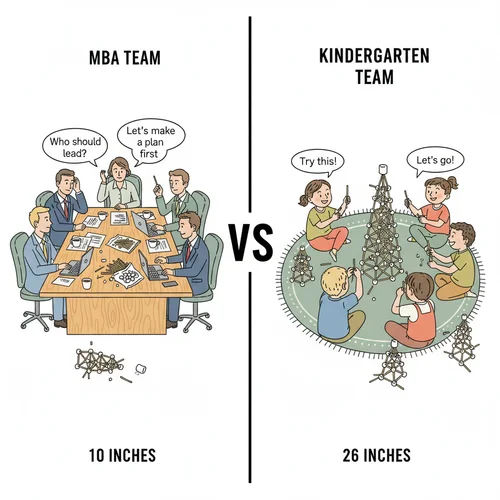
- Kindergarteners: 26 inches average
- Business school students: 10 inches average
- Many MBA teams scored zero
This isn’t luck. It’s systematic failure.
What Happens in the Conference Room
MBA students’ time allocation:
11:47 - "Who should lead?"
11:49 - "Let's hear everyone's ideas"
11:52 - "We need a plan first"
11:58 - "Triangles or squares?"
12:03 - Someone finally touches the spaghetti
15 minutes gone. Spaghetti still on the table.
Kindergarteners?
They just start building. Tower falls, they laugh and rebuild. No talk.
The Hidden Cost of Status Management
What does business school teach you?
- Build strategic frameworks
- Manage stakeholders
- Avoid looking unprepared
- Document every decision
These skills matter. But there’s a side effect: you learn to “align” before doing anything.
Tom Wujec’s TED talk revealed MBA teams spend 15 minutes deciding “who’s CEO of Spaghetti Inc.” Not because they’re dumb—because they’re trained this way.
Kids don’t care who’s boss. They just want to build tall towers.
This waste happens in your company every day:
- 30-minute meetings that should take 5
- Emails CC’ing 10 people just for CYA
- Week one of projects is “alignment” (really: political positioning)
The Trap of Surface Harmony
MBA teams look more professional:
- Taking turns speaking
- Building consensus
- Using frameworks
But it’s all theater.
Skillman found these teams full of:
- Hesitation: “Will my idea sound stupid?”
- Hidden competition: Tracking who gets credit
- Fear of failure: Discussion feels safer than action
Kindergarteners argue openly: “No, that won’t work!” Then keep building. Their collaboration is messy but real. They watch the marshmallow, not each other.
The Google Wave Lesson
In 2009, Google spent 3 years building Google Wave.
Hundreds of engineers. Millions of dollars. Built on assumptions about how users “should” communicate.
Launch day: thunderous applause. 8 months later: shut down.
Why? They tested the “marshmallow” (real user needs) last.
Compare to iPhone: 18 months of aggressive iteration. Jobs threw early versions across the room. Not because he was mean—because he refused to wait until the end to test.
Three Deadly Failure Modes
After facilitating 50+ games, I’ve identified three ways adults sabotage themselves:
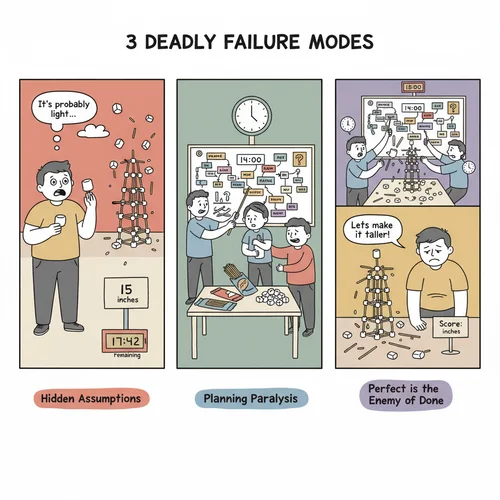
Failure Mode 1: The Assumption Trap
Time remaining: 17:42
MBA team: “The marshmallow’s pretty light, right?” “Yeah, and spaghetti sticks are basically beams.” (Nobody picks up the marshmallow)
Time remaining: 0:05
Place marshmallow. Tower collapses instantly.
“Wait, how much does this thing weigh?!”
Too late.
In your company, this looks like:
- Spending 6 months on features nobody asked for
- Rebranding without asking customers
- Assuming “best product” means sales will close big deals
Kids test the marshmallow weight in minute 2. To them, assumptions are just “guesses that might be wrong.”
Failure Mode 2: Planning Paralysis
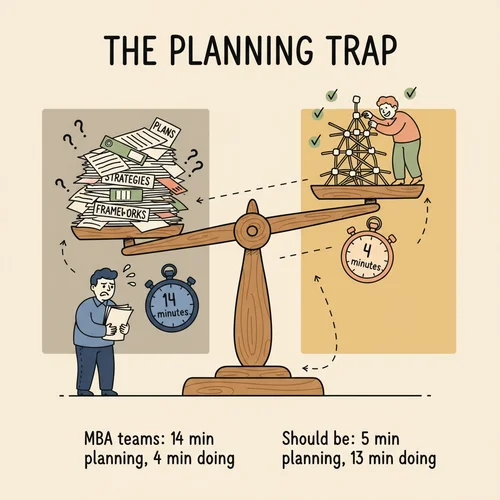
I timed one business school team:
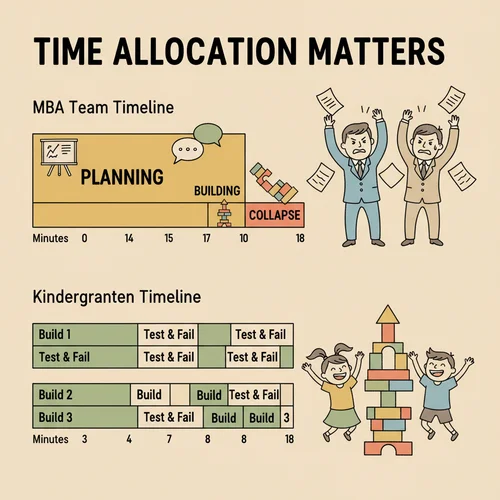
- Planning: 14 minutes
- Building: 4 minutes
Timeline:
Minutes 1-8: Whiteboard session
Minutes 9-14: Debating triangle vs square base
Minutes 15-16: Frantic building
Minute 17: Place marshmallow
Minute 18: Watch it fall
Post-mortem: “We just needed more time to build.”
Wrong. You needed less time to plan.
Kindergarten timeline:
Minute 1: Build something
Minute 3: Falls
Minute 4: Try different way
Minute 7: Falls again
Minute 9: Completely new approach
Minutes 10-18: Iterate, iterate, iterate
Result: Wobbly but standing tower
Bezos said most decisions need 70% of the info you wish you had. Wait for 90%, someone else ships first.
Failure Mode 3: The Perfectionism Curse
Worst failures happen at time remaining: 17:30.
Team has a standing structure. 15 inches tall. Marshmallow on top. It works.
Someone says: “Should we try to make it taller?”
Everyone nods: “We have time.”
Dismantle. Attempt ambitious redesign. Time runs out. Score: 0 inches.
Kids rarely do this. Why? They’re satisfied with “good enough.” No ego investment in building the “best” tower—just want the marshmallow to stay up.
Business version:
- Startup spends 2 more years “perfecting” product, market moves on
- Rebrand tweaked endlessly, ships 6 months late, 40% over budget
What High-Performing Teams Actually Do
After 50+ teams, winners share patterns:
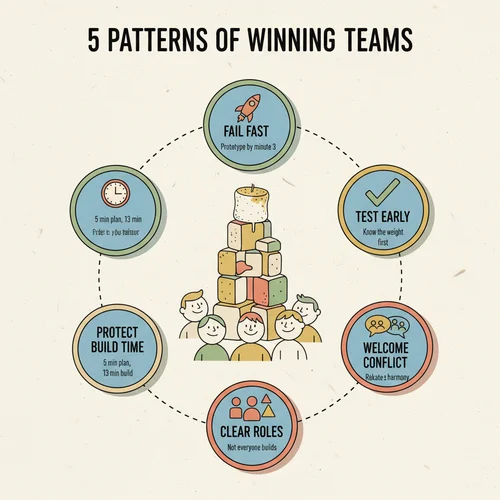
- Fail fast (first prototype by minute 3)
- Test early (understand marshmallow weight before building)
- Welcome conflict (real debate > fake harmony)
- Clear roles (not everyone needs to touch everything)
- Protect iteration time (5 min planning max, 13 min building)
Interestingly, architects and engineers consistently win. Not smarter—just:
- Know triangular structures distribute weight
- Test early and often
- Respect physics over politics
Use This to Diagnose Your Team
Don’t run this as “fun team building.” Run it as organizational health diagnostic.
Setup (5 minutes):
- Teams of 4-5
- Materials: 20 spaghetti sticks, 1 yard tape, 1 yard string, 1 marshmallow
- Timer: 18 minutes
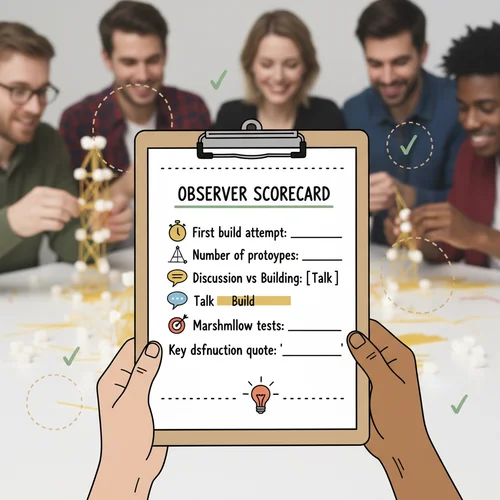
- One observer per team (critical!)
Observer scorecard:
First build attempt time: ____
Number of prototypes built: ____
Discussion vs building ratio: ____
Marshmallow tests: ____
Key dysfunction quote: ____
Debrief questions (don’t skip):
- Who became leader? Earned it or assumed it?
- When did you first test marshmallow weight?
- What % time was planning vs building?
- Did anyone suggest quick prototyping? What happened?
- How does this mirror your actual project workflow?
Last question is key. I’ve watched teams have real breakthroughs:
“Holy shit, we do this with products—perfect the pitch deck for 3 months, build the feature in 2 weeks, then wonder why it doesn’t work.”
The Curse of Expertise
The Marshmallow Challenge reveals a truth Silicon Valley gets but corporates resist:
When expertise teaches you to optimize for the wrong things, it becomes a liability.
MBA programs teach you to:
- Build comprehensive strategies
- Manage expectations
- Avoid visible failure
- Document decisions
These matter. But when they dominate, they crowd out:
- Rapid experimentation
- Tolerance for mess
- Bias for action
- Learning from failure
Kids haven’t been “trained” yet. They still work like startups: build → test → learn → iterate.
The question isn’t “should we hire more kids?” It’s:
How do we stop organizations from systematically killing adults’ “kindergarten behaviors”?
Advice for Different Roles
If you’re a product manager:
Track this metric next week: time discussing work vs time doing work.
If it’s not at least 3:1 favoring doing, you have a marshmallow problem.
If you’re a founder:
What does your culture reward? Fast failure or polished presentations?
Who gets promoted?
If you’re a team lead:
Try cutting your planning meetings in half. Use saved time for prototypes.
See what happens.
Final Thought
Most expensive phrase in any organization:
“Let’s schedule another meeting to discuss the approach.”
Sometimes the fastest way forward is:
Pick up the spaghetti. Start building.
Want to try the Marshmallow Challenge with your team? See our complete guide with materials and facilitation tips.
Related: