 Ice Breaker Games
 Find Something in Common
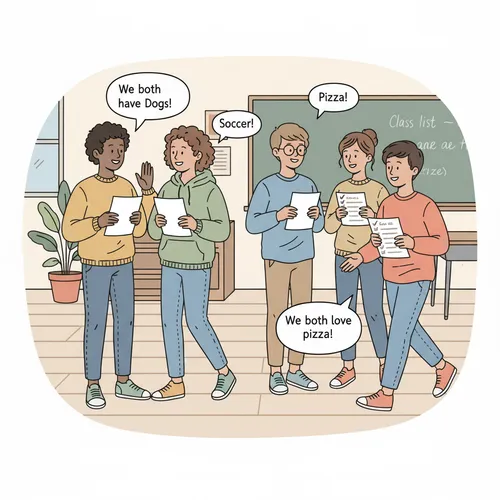
Get a list of classmates to talk to and find one thing you share with each person - but you can't reuse the same commonality. Forces deeper conversations when surface stuff runs out.
Group Size:
10-30 people
Duration:
10-15 minutes
Difficulty:
Easy
How to Play:
- 1
Give each student a list of 5-8 names of other students in the room
- 2
Students walk around and talk to each person on their list
- 3
Find one thing they have in common with that person and write it down
- 4
The catch: You can't use the same commonality twice. If you both love pizza, you can only use that once
- 5
First person to complete their list wins, or set a 10-minute timer and see who gets the most
Find Something in Common exposes how little we actually know about the people around us. Give everyone a list of 5-8 names and one rule: find something you have in common with each person. But you can’t use the same answer twice.
The no-repeat constraint is what makes this work. The first two conversations are easy—you both like pizza, you both have siblings. By conversation four, students are asking about childhood fears, weird talents, places they’ve dreamed of visiting.
Surface-level small talk becomes impossible when all the surface answers are used up. Teachers report discovering students who’ve known each other for years finding out they share obscure interests they never discussed.
Best For:
First day of class, team building, helping students discover unexpected connections, breaking up cliques. An ice breaker game that forces deeper conversations through its no-repeat rule.
Pro Tips
-
Make the lists random so students talk to people they don't usually hang out with
-
Give examples of what counts: hobbies, favorite foods, number of siblings, travel experiences
-
Encourage students to go beyond the obvious. 'We both go to this school' doesn't count
-
Walk around and eavesdrop - you'll learn so much about your students
-
For large groups, give shorter lists of 3-5 names so it doesn't take forever
Variations
-
Speed version: Give everyone 2 minutes per person, then rotate
-
Bingo card: Instead of a list, create a bingo card with commonalities to find
-
Three things: Find three things in common with each person, ranging from obvious to unique
-
Remote version: Use breakout rooms and a shared doc where pairs write their commonalities
FAQ
- Why does Find Something in Common create deeper conversations?
- The no-repeat rule is genius. By person number four or five, students have used up obvious answers and must dig deeper. They ask about siblings, travel, fears, dreams—things they'd never discuss in normal small talk.
- What if two people can't find anything in common during Find Something in Common?
- Keep digging. Everyone shares something—favorite season, number of siblings, food they hate, places they want to visit. The struggle often leads to the most memorable discoveries. This ice breaker game rewards persistence.
- How do I create the name lists?
- Randomly assign names to ensure students talk to people outside their usual friend groups. Mix grade levels, backgrounds, and social circles. The discomfort is the point.
- Can Find Something in Common work with adults in the workplace?
- Absolutely. This ice breaker game helps break down departmental silos. Discovering you share something unexpected with someone from another team creates real connection, not just networking.
- What counts as a valid commonality?
- Hobbies, interests, experiences, preferences—but not obvious things like 'we work here' or 'we're both humans.' Push for specificity. 'We both have visited Japan' beats 'we both like travel.'
Related Games
Human Knot
A circle of people grab random hands across and untangle themselves into a ring—without ever letting go. Sounds simple until you're stepping over someone's arm.
Story Building
Someone starts with 'The marketing team found a hidden door.' By sentence ten, a dragon is filing taxes. Each person adds one sentence. The story goes wherever the group takes it.
Desert Island
Your coworker chose a family photo over a knife. Now you know something. Pick 3 items for a desert island and explain why. Choices reveal values.
Scavenger Hunt
Find a red stapler. Take a selfie with someone wearing stripes. Complete 15 tasks in 20 minutes. Teams race, strategize, and bond over absurd challenges.
Build Stronger Team Connections
Break the ice and foster closer relationships with our curated games.
Games