 Ice Breaker Games
 5 No-Prep Icebreakers For Adults
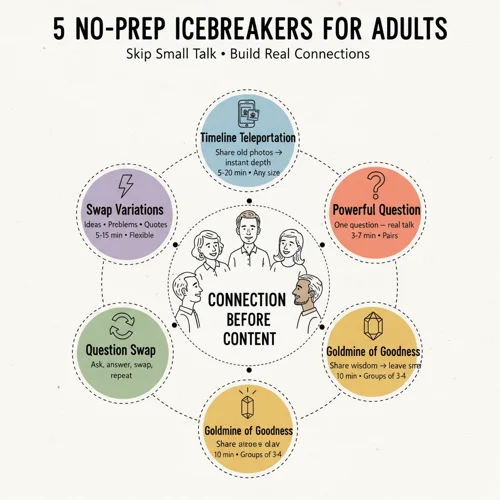
If you are leading a room of adults and want an icebreaker that is genuine, purposeful, and not cringey, these five no-prep techniques are what I use most. The goal is not small talk for its own sake. Think of an icebreaker as a painkiller, not a vitamin: skip the awkward five to ten minutes of surface-level chit chat and create space for meaningful connection right away.
Two quick pieces of framing before we dive in:
Drop the phrase icebreaker. Many adults react negatively to that word. Instead frame the activity as connection before content. That sets a purpose: connection matters so the rest of the meeting can matter more.
Assume the social risk. As the facilitator, take the risk off the group by giving clear prompts and safe structures. Adults will step in and share when the environment feels low-risk and meaningful.
Overview
These five exercises are zero prep, use things people already have (like phones), and lean on adults life experience so conversations arrive at depth quickly.
- Timeline Teleportation
- Assume the Risk: Ask One Powerful Question
- Goldmine of Goodness
- Question Swap
- Swap Variations: Idea, Problem, or Quote Swap
1. Timeline Teleportation
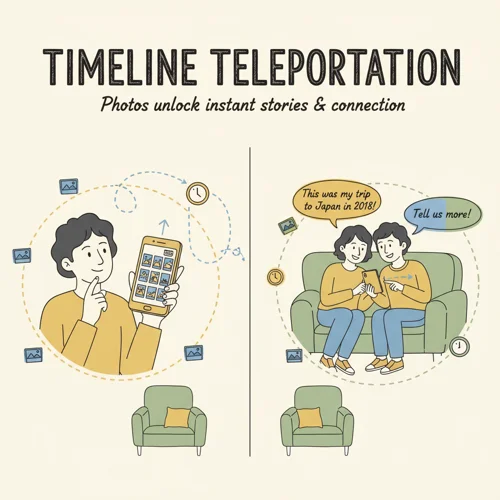
Why it works: Adults have decades of memories captured on their phones. When you pair a photo with a person and a story, that memory sticks. Photos are highlights people chose to keep. Asking someone to pull up an older photo transports them instantly into a meaningful moment.
How to run it
- Ask everyone to open their photos app on their phone and scroll to an older photo (you can specify a timeframe like “pre-2020” or “five years ago”).
- Have people pair up or form small groups and share the photo and its story.
- Give 5 to 20 minutes for sharing, depending on your available time.
- Debrief with a quick group question: What struck you about those conversations?
Debrief notes: Responses typically focus on group culture—how open people were, how good it felt to share—establishing safety and purpose for the rest of your time together.
2. Assume the Risk: Start with One Powerful Question
The simplest teleportation is a single well-chosen question. Powerful questions give people permission to talk about what matters to them and remove the burden of inventing something safe to say.
Examples of questions
- What is one of your favorite topics to talk about?
- What goal are you planning to accomplish this year?
- What hobby or interest always gets you animated?
How to use it: Pose the question, give a minute of reflection, then pair people to share for 3 to 7 minutes. Because adults choose how to answer, the same question can result in light, deep, or practical conversation depending on the person.
3. Goldmine of Goodness
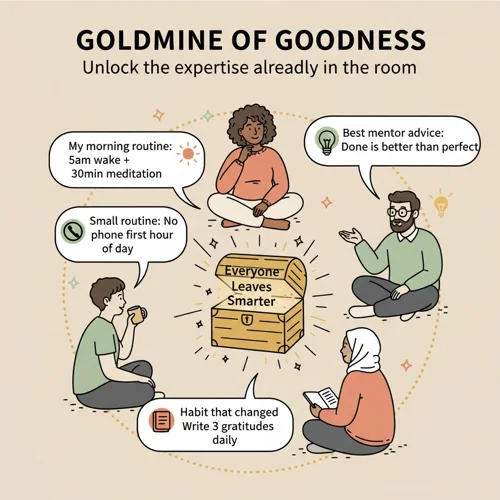
Your group is full of expertise. This exercise unlocks it. Ask attendees to pull a piece of wisdom, advice, or habit from their mental filing cabinet and share it with others. Everyone leaves smarter.
Sample prompts
- What is one habit you have stuck with and how do you maintain it?
- What is the best thing a mentor ever told you?
- What small routine has made the biggest difference in your work or life?
Format: Small groups of 3 or 4 work especially well. Each person shares their item and how it helped them. After 10 minutes, the group will have collected multiple practical takeaways.
4. Question Swap (My Favorite)
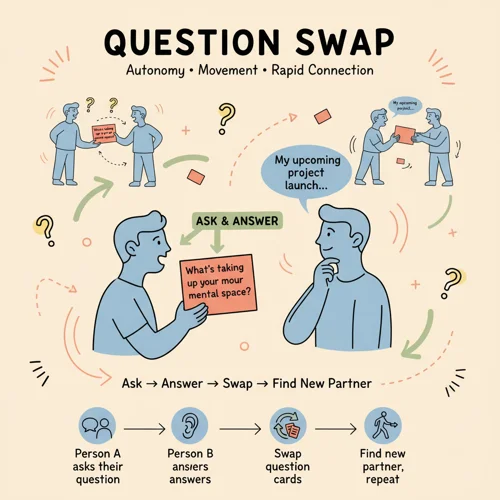
This scalable exercise creates autonomy, rapid connection, and movement. Every participant has a single question, pairs up, asks and answers, then swaps questions and finds someone new.
How to run a question swap
- Give each person a question card or prompt (these can be single typed questions on scraps of paper).
- Pair people up. Person A asks their question, Person B answers. Then Person B asks their question, Person A answers.
- After the exchange, participants swap cards, find a new partner, and repeat.
- Continue for 5 to 20 minutes depending on group size and energy.
Why it is powerful: Adults get full choice in how they respond. Conversations can be very short or extend naturally into deeper connections. The swapping mechanic self-facilitates movement and keeps energy high.
Question examples for swaps
- What is taking up a lot of your mental space lately?
- What book, podcast, or idea changed the way you work?
- What small habit has improved your life the most?
5. Swap Variations: Idea Swap, Problem Swap, Quote Swap
Take the question swap mechanics and swap the content to fit your context. The structure is the same—pair, share, swap—but the prompt changes to meet your goals.
Idea Swap: Share one idea you are excited about and get quick feedback.
Problem Swap: Share a challenge you are facing and get a few minutes of peer coaching.
Quote Swap: Share a favorite quote and why it matters to you for a lighter, reflective option.
Timing and tone: Make problem swaps short and focused if the content is heavy. Idea swaps can be slightly longer to allow for creative feedback. Quote swaps are great when you want something low-risk and inspiring.
Facilitation Tips
- Always connect back to purpose. Use a quick debrief question that asks what people noticed about the culture or conversations.
- Provide clear time cues. Adults appreciate knowing exactly how long they will speak.
- Encourage autonomy. Explicitly say people can choose how deep to go; that freedom increases participation.
- Assume the social risk. Model openness and provide the structure so participants do not feel exposed.
“Listening, and being willing to be changed by the other person, is one of the most powerful gifts we can give in an icebreaker.”
Wrap Up and Tools
Each of these no-prep approaches teleports participants past small talk to conversations that matter. They work in rooms of 12 or 1,200, in-person and virtual, and require nothing more than people’s attention, a phone, or a single question card. If you want ready-made question decks or printable prompts, I offer practical tools designed to make facilitation easy.
Try one of these at your next meeting and notice how quickly the tone changes. When connection comes before content, adults engage more deeply, learn from each other, and leave smarter than when they arrived.
Need more team building resources? Check out our other articles: